
Stickman Hook Scratch: Master the Grappling Hook
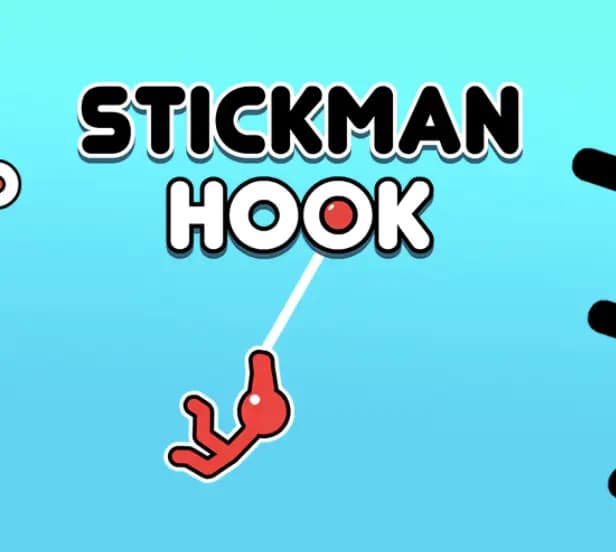
Stickman Hook Scratch is a physics-based arcade game where timing and momentum control everything. You swing a stick figure through levels using a grappling hook that latches onto anchor points, requiring you to release at the right moment to launch forward and avoid hazards. The minimalist visuals hide a deceptively tricky challenge that rewards precision and practice.
How the hook mechanics work
The core mechanic is simple but demands skill. Click or tap to fire your hook at an anchor point ahead. Once it latches, you swing like a pendulum. The longer you hold before releasing, the more momentum you build, but release too late and you swing past your target or crash into an obstacle.
Each anchor point is placed to force decisions. Some are high, some low, and some are partially hidden by hazards. Learning the spacing between points teaches you how much momentum different gaps need. Early levels feel forgiving because anchor points are generous and widely spaced. Later stages cluster them tightly or place them in awkward positions that demand millimeter-perfect timing.
Building and controlling momentum
Momentum is your currency in Stickman Hook Scratch. A weak swing barely carries you to the next anchor. A strong swing overshoots and sends you into spikes or walls. The physics engine is consistent, so once you understand how much momentum a full pendulum swing generates, you can predict distances.
The trick is learning intermediate releases. You do not need to always swing to the absolute peak. Releasing at 70 or 80 percent of your swing gives finer control for tricky gaps. Some players develop a feel for half-swings, quarter-swings, and full arcs without thinking about percentages. It becomes muscle memory.
Hazards are placed to punish both over and under-shooting. Spikes on the left side of a gap mean you cannot build too much leftward momentum. Walls on the right force smaller releases. The level design teaches you through consequence, which is why the later stages feel satisfying once you adapt.
The difficulty curve
Early levels are tutorials in disguise. You learn that anchor points are your lifeline and that swinging into empty space ends runs. By level 10 or so, obstacles start appearing between anchor points. You swing past platforms with spikes on top, or navigate around moving hazards. The pacing lets casual players progress while giving skilled players a climbing challenge.
Later levels introduce anchor points that are offset from straight paths, forcing you to swing diagonally. Some require you to chain quick successive releases to carry momentum through tight corridors. The final stages combine everything: precise timing, momentum control, and spatial awareness all at once.
The addictive loop is clean. Each level is short enough to retry instantly if you fail. There is no penalty for death beyond replaying the few seconds you just lost. This design keeps frustration low while the difficulty stays genuinely hard.
Why Stickman Hook Scratch endures
The minimalist art style keeps visual noise out of the way. You focus on the hook, the anchor points, and the hazards. This clarity is why the game works on mobile and browser without needing a powerful device. Play Stickman Hook free on Dubdoo directly in your browser.
Stickman Hook Scratch is part of a larger family of physics-based arcade games on Dubdoo. If you enjoy the momentum-based movement here, games like Ragdoll Archers and Ragdoll Hit offer different takes on physics and timing. Both are similarly playable without download, fitting the same casual-but-challenging niche that makes Stickman Hook Scratch popular at school.
The game also shares DNA with other Action Games on the platform, though Stickman Hook Scratch's focus on one core mechanic sets it apart. Titles like Awesome Tanks 3 layer multiple systems, while Stickman Hook Scratch lets pure execution shine.
Master the timing
The real skill in Stickman Hook Scratch is internalizing the physics. Experienced players stop thinking about percentages and just feel when to release. You develop an instinct for how far a three-quarter swing carries, or how a short tap from a low anchor behaves. This intuition comes from repetition.
Practice early levels until the timing feels natural. Then challenge yourself to find alternative paths through later stages. Some levels have multiple anchor sequences that work, and experimenting teaches you the full range of what the physics engine allows. You might discover that a counter-intuitive swing path actually works better than the obvious route.
FAQ
How do I attach the hook in Stickman Hook Scratch?
Click or tap to make the hook latch onto an anchor point. The timing matters because you need to attach at the right moment to build momentum for your swing.
What's the best strategy for swinging through levels?
Release at the peak of your swing to launch forward with maximum momentum. Practice the timing on early levels to understand how long to hold before releasing.
Are there different difficulty levels?
Yes, levels get progressively harder with more complex obstacle layouts and tighter timing windows. Each stage introduces new challenges to master.
Do I need to download Stickman Hook to play?
No, you can play Stickman Hook free directly in your browser on Dubdoo without any download required.