
Stickman Hook 3: Master Grappling and Swinging
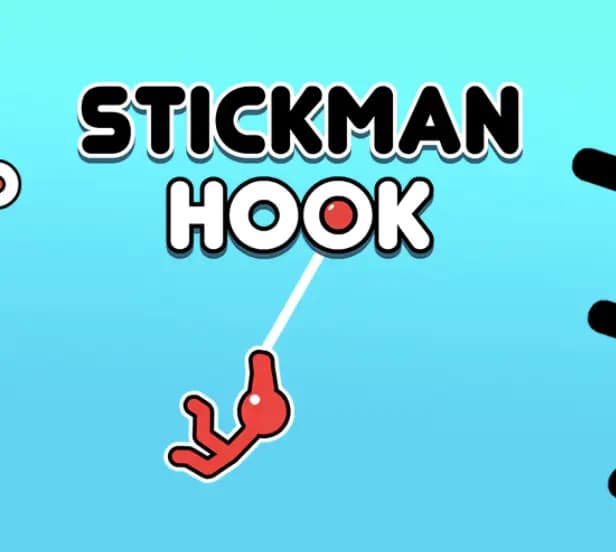
Stickman Hook is a physics-based arcade game where precision timing and momentum control separate casual players from level-beating pros. While there is no official "Stickman Hook 3" sequel, the base game delivers endless challenge through dozens of progressively harder levels that teach you to master hook attachment, swing arc calculation, and the split-second release timing that lets your stickman soar.
How the hook mechanics work
The core of Stickman Hook is simple: tap to latch your hook onto an anchor point, hold to build swing momentum, and release to launch forward. The physics engine rewards timing over reflexes. Your stickman swings like a pendulum, and the longer you hold, the higher the arc. This means you cannot simply tap and release instantly. Early levels train you to feel the swing rhythm, but later stages introduce anchor points so close together that a split-second mistiming sends you backward or into spikes.
The hook attaches to any visible anchor point on screen. You do not choose which one. Understanding where the nearest anchor lies before you swing is half the battle. Scanning the level layout for anchor chains helps you plan your path instead of reacting moment by moment.
Building momentum on open sections
Levels with wide gaps and spaced-out anchors reward aggressive swinging. Hold the hook longer here to build velocity. Your stickman gains speed by swinging through a full arc before release. On wide-open stretches, releasing at the bottom of the swing rather than the peak actually gives you more forward distance because you are moving horizontally at speed.
Contrast this with narrow corridors. Confined spaces demand gentle taps. A full swing crashes you into walls. Short holds and early releases keep your arc tight and your path predictable. Many players fail tight sections because they apply the wide-open strategy everywhere. Each level type requires a different release philosophy.
Obstacle recognition patterns
Spikes, moving platforms, and narrow gaps create the puzzle layer beneath the action. Before you attempt a section, glance at what hazards line the path. Spikes always kill on contact, so you need clearance. Moving platforms require you to time your landing, which means controlling your swing length to hit them at the right moment. Some platforms move slowly, giving you a wider window. Others zip across the screen, asking for frame-perfect precision.
Walls are your friend on tight turns. A wall does not hurt you in Stickman Hook. You can swing into a wall, slide along it, and detach to find your next anchor. Using walls as a pause point or redirect tool opens up level solutions that pure swinging cannot achieve.
The difficulty curve and when to pause
Early levels ease you in with widely spaced anchors and no hazards. By level 10, spikes appear. By level 20, the anchors are so close that swinging feels cramped, and moving platforms force you to judge timing. The jump from level 15 to level 20 is where most players hit a skill ceiling and take a break.
This is normal. Stickman Hook is designed to teach incrementally. If you are stuck, go back and replay a few earlier levels to re-groove your timing. Your muscle memory sharpens with repetition, and returning to a hard level after a session away often feels easier because your brain has processed the pattern overnight.
Free play on Dubdoo
Play Stickman Hook free on Dubdoo directly in your browser. No download, no installation, no account needed. The game fits perfectly in a study break or a quick gaming session between classes. If you like physics-based challenges, Dubdoo also hosts similar action games like Ragdoll Archers and Ragdoll Hit, which share the same momentum-driven, timing-focused gameplay.
Practice drills for stuck levels
When you hit a wall, isolate the problem section. Does the first swing work? If so, focus only on the second swing and anchor chain. Does the third swing trip you up? Replay the level 10 times focusing only on that sequence. Breaking a hard level into three or four micro-sections makes progress visible instead of feeling like a plateau.
Many players also switch game modes or try a sibling title from the Action Games category to refresh. Playing 1 vs 1 Build Now GG or Awesome Tanks 3 for 10 minutes and then returning to Stickman Hook often resets your focus and reveals solutions you missed.
Why the swinging feel matters
Stickman Hook succeeds because the physics feedback is tight. When you misjudge a release, the stickman does not teleport or glitch, it simply falls or bounces in a way that makes sense. This clarity builds trust. You blame yourself, not the game, when you fail. Over time, that feedback loop trains your intuition, and levels that looked impossible become reflex.
The minimalist art style (black lines, simple geometry) also keeps the visual focus on motion and timing, not distraction. Dubdoo's browser platform runs the game smoothly without lag, which is critical for a title where milliseconds matter.
FAQ
How do I time my swings in Stickman Hook?
Release your hook when your stickman reaches the peak of the swing for maximum forward momentum. Releasing too early sends you into obstacles, while releasing too late causes you to drop straight down. Practice on early levels to build rhythm.
What's the best strategy for tricky levels?
Approach each level by studying the anchor point placement before rushing through. Use gentle taps rather than aggressive swings on narrow passages, and build momentum on open sections. Patience beats speed in later stages.
Can I play Stickman Hook on Dubdoo without downloading?
Yes. Stickman Hook runs free in your browser on Dubdoo with no download required. Just click to play immediately.